
Government / Client project
A structured workflow for staff appraisal.
A role-based application supporting performance-appraisal submissions, reviewers, and the staff records behind the process.
- Project
- DUPAK
- My role
- Backend and application developer
- Scope
- Appraisal submissions, reviewer workflow, and staff administration
- Built with
- Laravel 7, PHP 7.4, MySQL, Blade
- Period
- 2021 · repository activity
- Project status
- Historical work
Engineering focus
Structured appraisal submissions
Laravel models and routes cover appraisal submissions, detailed activity entries, revisions, appraisal periods, and reviewer teams behind a role-based workflow.
Administrative records and outputs
Searchable DataTables, staff and reviewer administration, spreadsheet export, and PDF report views support the process after submission.
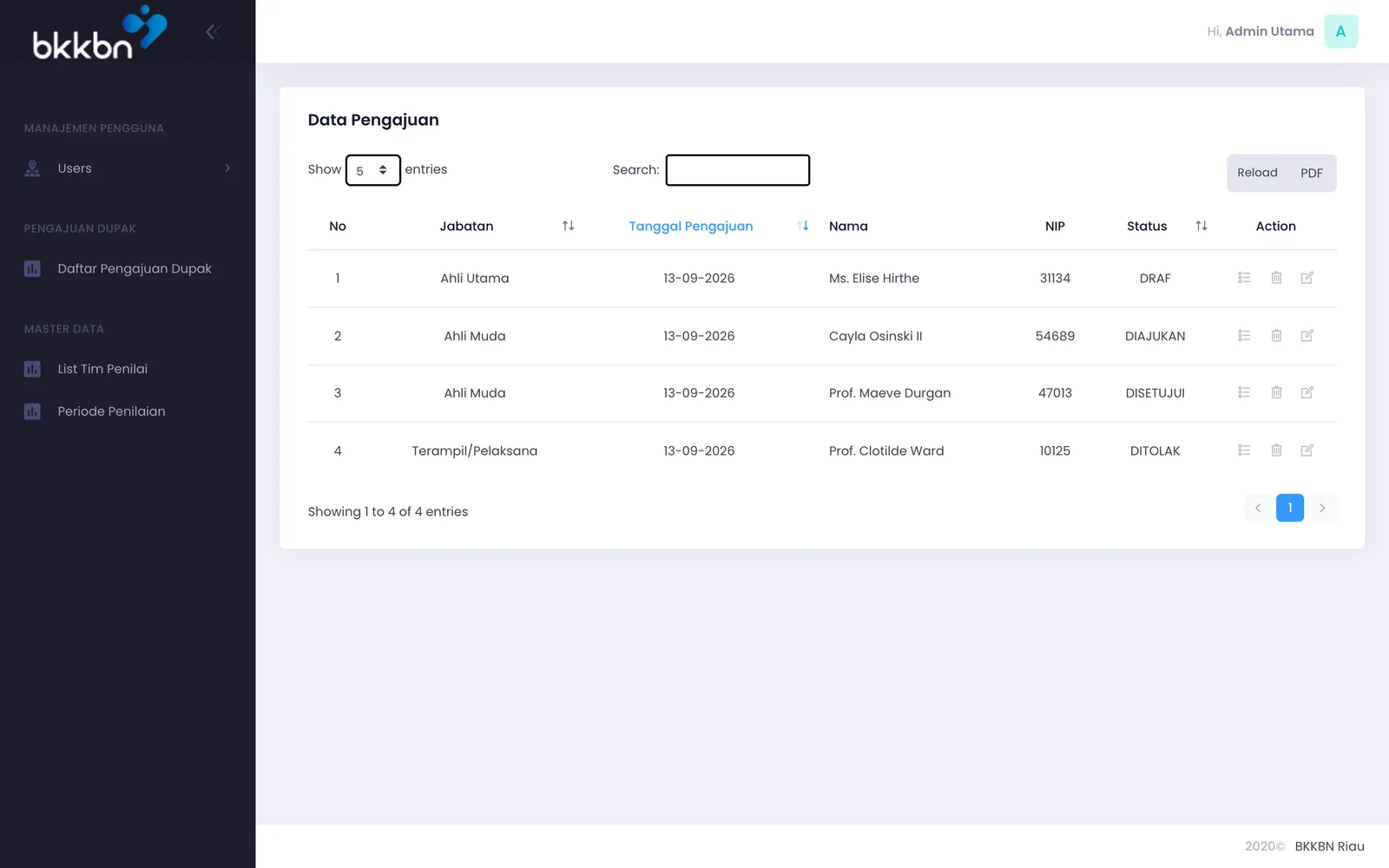
Client project for BKKBN, a national government agency, supporting an employee performance-appraisal process. This is a real local capture with synthetic sample data; no live employee information is shown.
The available shallow clone history contains activity on 2021-01-25; the archive manifest also records 2020-08–2021-01, but the earlier boundary is not verifiable from this clone. Current availability and maintenance of this historical application are unverified.
Give an appraisal process a dependable record
Performance-appraisal work involves more than collecting a form. Submissions need to be connected to the right period, reviewed by the right people, and tracked through a clear status from draft to decision.
DUPAK provides that structure in a role-based web application. Staff can work with appraisal submissions, while administrators manage periods, reviewer teams, staff records, and the access needed for each part of the process.
Make the workflow traceable
The submission view gives the people running the process a searchable list of records, roles, dates, and review states. The underlying application models submissions, supporting details, revisions, reviewer teams, and appraisal periods so the work can move through a defined workflow.
I contributed to the Laravel backend and application development. The project uses MySQL, Blade, role permissions, data tables, spreadsheet export, and PDF generation to support the administrative process.
Preserving the evidence without exposing records
This case study uses a real locally running version of the historical application. The screenshot contains synthetic sample names and identifiers only; it demonstrates the workflow without exposing employee records or claiming the sample statuses are production data.